
NDD – the new ADHD – let’s tweet about it.

117Nature Deficit Disorder. It’s the new rage. It’s the new Attention-Deficit-Hyperactivity-Disorder. It’s a first world problem, in our first world urban societies, where a blend of various socio-economic and cultural populations mix and segregate themselves amidst a bombardment of technological and material stimulation. We – kids, people – are deficient in nature and a sense of connection.

On Facebook the other day, I saw a post that a few friends had spread around that was a picture of a black board in a coffee shop that read “No, we don’t have Wi-Fi – Talk to each other”.

The number of times I have wanted to delete my Facebook account, throw my iPhone away, run into the woods for a few days, and sell my car… The number of times a friend/family member/ client has told me they want to delete their social media accounts, throw their phones away, escape the city, leave their lap-tops behind, and sell all possessions… The numbers are high and the funny thing is, many of us do it, take a break from it all, and then come right back to it once we have had a bit of space to breathe and once we feel grounded again and re-crave that access to social inclusion that our innovators have so creatively designed.

How easy it is to get consumed and swallowed up by a world of innovation that is fueled by greed and capitalism and all the possibilities that are promised for a life of happiness via advertising and testimonials. The innovation, technology, and creative material designs we humans have come up with are brilliant. unbelievable, actually. The problem is, many of these creations have brought changes to the way we relate to one another, to our surroundings, to the food we eat, and to the way we care for ourselves and others. Some changes have been good experiences, and others not so good.

8 year old kids don’t need cell phones. Teens don’t need to spend their evenings on facebook spying on one another and plotting their drama for the next day. Schools don’t actually need smart boards cause they don’t actually improve the level of education the students receive – teaching, curriculum revisions and engaged social interactions improve the way kids/people learn.

I advocate for greater connection with nature as I sit here blogging about it.

I feel better when I am harvesting potatoes.

Today, I will make salsa.


I like myself so much better when I do

089While in Newfoundland, for a family vacation, we stopped in for lunch at the Fogo Island Inn – a 5 star hotel built on the most eco-friendly principles possible and which has been the subject of much controversy among locals (from what we read and heard) who aren’t sure whether or not they support the new, large piece of architecture that may contribute to or deplete the rest of the community’s economy. Based on my very very short experience there, an evident collaborative process has been put in place to contribute to and involve the Fogo Island Community, while preserving and sustaining local traditions in beautiful and innovative ways. Having only very recently opened, one would hope, like for any small community, that the skeptics are won over by the continued integrity of the Inn’s mission and vision.

http://www.fogoislandinn.ca/

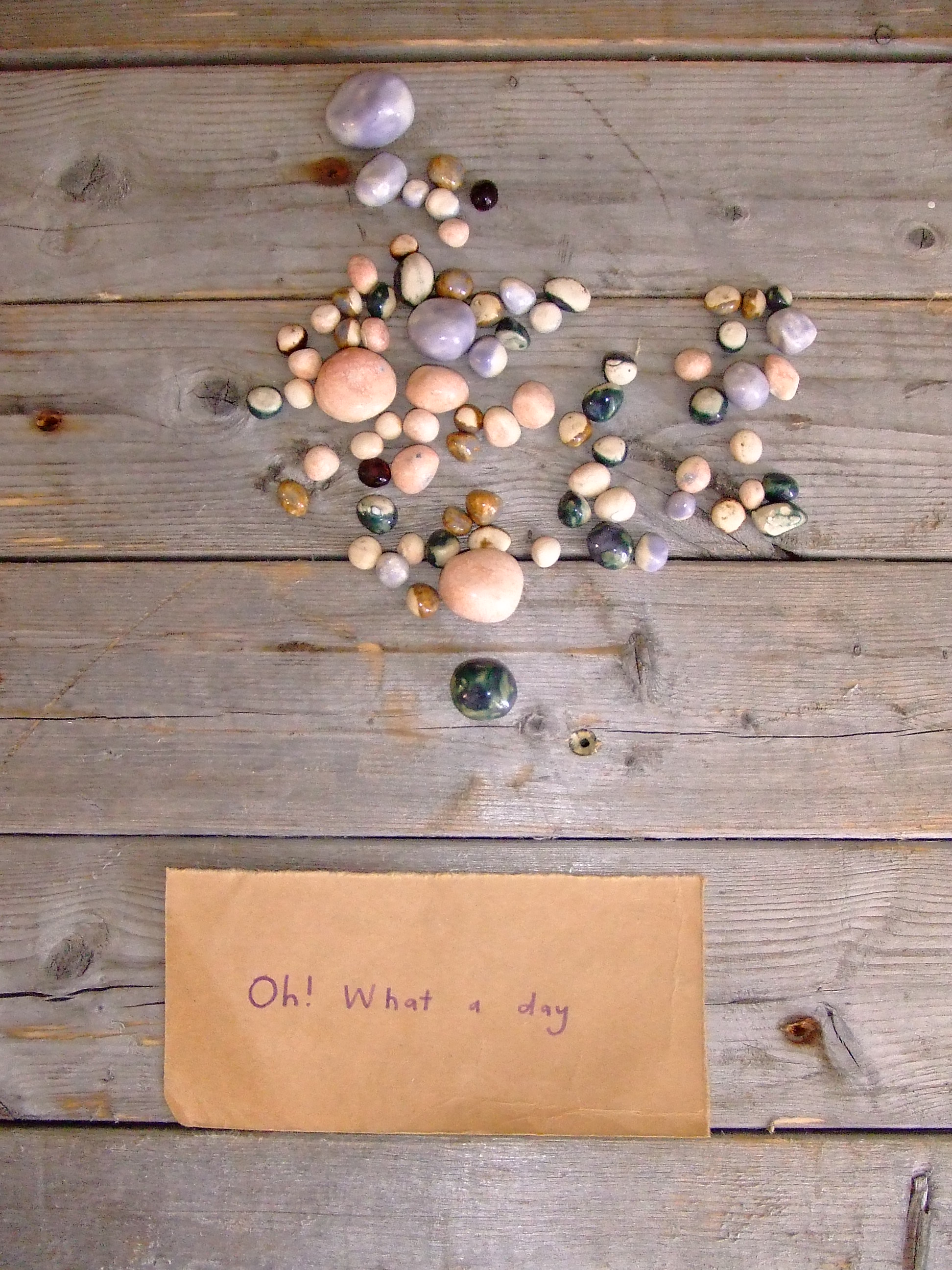
As impressive as the solar panels, rain water irrigation system, wood-fired sauna, and the actual ghost-like white boxy structure of the place were, it was the art and simplicity of it’s presence and everything in it that struck me. The Art Gallery had an exhibition by Kate Newby. The cutest little series of rock formations that sent very simple messages – the kind of lessons we adults can learn from children. Among my favorite, was the little cardboard note I like myself so much better when I do.  Others included Oh! what a day, Holding onto it only makes you sick, and Little Saturday.

082085087I hope it’s ok for me to be sharing photographs of these installations. They inspired a creativity in me that I had temporarily been suspended. A friend of mine likes to say at the end of every day “Today is the best day of my life”, and he makes a point of making every day the best day of his life. Just like one would marvel with child-like qualities in a plain-old Little Saturday.

Dear Anxiety…

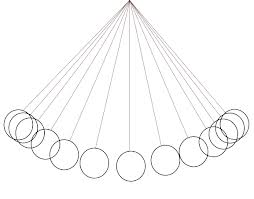
pendulumOur minds are like a pendulum. At rest, the mind is centered, weighted/grounded, motionless, peaceful. When the fluctuations of the mind begin to stir, they sway back and forth between past and future events. When the mind is very agitated, it tends to take longer and longer journeys away from its center. For some, those journeys into future-based anxiety and past-based dwelling, can be far apart in time. For others, the mind travels greater distances within a day, maybe even multiple times within one day or within a matter of minutes – rarely pausing. Part of the practice of cultivating a sense of stability and ease within the mind is to train it to stay closer to its center, while allowing it to journey back and forth within limits that serve you in your growth and development.

What is anxiety? What does it serve? Why is it so prevalent? What are we to do about it? How do we help ourselves and others when anxiety, in disproportion to what’s actually happening in reality, looms.

After an 8 hour shift of crisis counselling, with 4 high priority clients whose anxiety had risen to a level of creating dysfunction and suicidal ideation, I found myself sitting at home asking myself all of the questions above. When you really think about the adverse impact that our own sense of chaos can have on our health and happiness, it really makes you wonder what the point of it all is. From an outsiders perspective, heightened distress can be transparently useless… or useful, depending on how you look at it and understand the underlying purpose that it can and does serve. When you’re the one who is feeling anxious, however, it doesn’t matter how much awareness you have about the irrationality of your thoughts, you end up feeling lost, panicky, and foggy. Over time, we learn to deepen the awareness and prevent the anxiety before it takes over.

If you were to externalize your anxiety (whether it be mild, moderate, severe, extreme) and write a letter to this infamous Mr. Irrational Stressy-Pants and make a request, what would you say? Hey Mr. I. S.-P., can you cool it? Dear Mr. I., I would really appreciate it if you would stop exaggerating and creating drama in my life. Dear I. man, you aren’t making any sense. Can you please give me some space? Stressy-Pants: this isn’t helping the situation. Can you please talk to Mr. Rational Happy-Go-Lucky? Or… would you soothe your Mr. Anxiety, but telling him (not sure why it’s a him) that everything is going to be ok? You don’t have to freak out, I am right here for you and can take care of it. There isn’t anything to worry about. What if… what? There is no “what if”, there’s only “what now”.

Let’s look at some of the possible functions anxiety does and can serve. Within a healthy experience of it, it can get us moving and shaking stagnant energy when change needs to happen. It can serve to motivate, fuel productive actions, and shift our direction. It can get us out of unsafe situations, inform us of our boundaries, and tell us to let go, quit complaining and do something about our circumstances. The thing is, in order for it to serve us well, we need to be connected with the signals of our bodies and at peace with who we are, just as we are in this present moment. We need to cultivate a state of mind that doesn’t deviate too far away from the here and now. Just like the analogy of the pendulum.

Anxiety also serves to relieve guilt. When I am late for a meeting by my own procrastinating ways, it’s easier to be stressed and dramatic about all the rushing around and apologizing for my tardiness because of how “stressed” I am than it is to stroll into a meeting late with ease. In other words, on a mild level, it protects the ego from looking bad. Are you a perfectionist? If yes, think about the purpose that anxiety serves in maintaining your patterns of needing to always do everything right, or else… Or else what? Rejection? Humiliation? Shame? Those only exist on an experiential level if you allow them to. How about pure habit and comfort level? If it’s in your history to have been under a lot of distress as a child, the anxiety might just be comfortable. In that “I like what is familiar” kind of way.

In more extreme cases, think about how fascinating the human nervous system is. We are animals. We, like any other species, is concerned with survival. In our most vulnerable moments, we seek protection from any threat – whether it be real or perceived. The nervous system eventually becomes trained to think, feel, and experience the world through a certain communication pattern. Integrating the mind and body and breath so they can communicate more effectively, allows us to re-educate your nervous system to understand the ways in which it can let go of what it no longer needs to protect us from.

All this said, your anxiety always has a message. Let go, change, look at the situation honestly and wholeheartedly with kindness and respect toward yourself and those around you. Bring your pendulum of a mind back to its center so you can live more freely.

Under stress, we tend to hold the breath at the end of the inhale. Instead, practice holding at the end of a long and complete exhale. Your nervous system will get the message.


There Are No Words To Describe True Freedom

557501_10151253056482578_278992766_nThere is a seed within each of us that represents our true nature – our full and most authentic potential. The degree to which that seed has thrived and is expressed, depends largely on the barriers of our own mind. When we don’t feel free to be who we truly are, we know it. When we do, we also know it.

True Freedom? It’s an experience. In my words, I would say freedom entails the opposite of distress; a complete sense of connection to that true self within you in a moment when you wouldn’t want to be anywhere else in the world besides where you are right then and right there. Living in the present moment – that’s where happiness can bloom. In the experience of freedom, people generally have clarity, confidence, and connection. Freedom is what everyone who is running around in the rat race of our society seems to be seeking. And yet, so many people run after freedom by building on the foundations of the restrictions created by the mind. In other words, we want freedom, yet we chase after it by doing things sometimes that we know very well are not an expression of our true selves. And then, we complain we aren’t happy or we feel stuck. So, we unstick ourselves – something that takes courage and self-awareness. And we start the cycle all over again in search of what an expression of our true potential really means. That’s the beauty of our human nature… you just have to be aware of when you aren’t aware, or you risk staying stuck and un-free forever.

Close your eyes for a moment and imagine yourself in a place you love, surrounded by people who bring out the best in you, and who give their love and kindness to the parts of you that have yet to grow. Let all of the obstacles of your mind melt away and just experience that connection to yourself. If you can’t access the experience on your own by imagining it, then make sure to re-connect with yourself by going out and doing something that brings you back home. Home, being the place within you that you love and will take you wherever you are meant to go. Dance, be in nature, be loving, receive a hug, create something, travel, see and experience something new, challenge yourself, listen, be open, be curious, and reflect on your actions and your commitments.

“Today you are you, that is truer than true. There’s no one alive who is you-er than you.” ~ Dr. Seuss

People who inspire us are usually people who express themselves freely and creatively. Be that inspiration for others and for yourself. And if you have a story of hardship – tell it, share it, and in a way that favours change and growth over stagnation and victimization.

Be free to be you.

How You Would Know You’re A Bilingual-Anglo-Québecer, Whose Identity Has Been Shaped By Your Franco-Québécois Upbringing

Casse-croute_Mont-Rigaud_021) When you bring one of your Anglo-non-Québécois friends to a “Casse-Croûte” called “Chez Ti-Cu”, you try to share the humour, but you can’t quite find a translation that gives the name justice. You don’t even bother mentioning the part about “Cu” not being spelled correctly.

2) When you speak French, you have a slight English accent and it takes people a few minutes to catch on and say “eh, t’es un(e) p’tit(e) anglais(e) toé”. You can also understand and imitate Joual and you might have a family member on one side of your family that speaks “avac une viaille p-h-atate chaude dans bouche”.

3) In elementary school, there were at least 3 kids in your grade by the last name Chevrier and half the kids at school or in your neighbourhood couldn’t quite pronounce your name properly.

4) At least your parents made a conscious effort to give you a first name that was bilingual. If you didn’t end up with one, they did consider the impact it would have and left it up to you to figure out a default pronunciation that would satisfy the non-bilingual friends you would eventually encounter.

5) You follow the unwritten rules of hugging your Anglo people, giving deux becs to the Franco friends and family members, and you encounter situations on a regular basis where you accidentally kiss someone on the nose, lips, or eyes because you are both confused about the appropriate greeting.

6) Comfort foods may include: brown beans, hot dog steamé (not to be confused with hot dog classic), split pea soup with ham chunks, pudding chômeur, hot-chicken, mashed potatoes with powder gravy, and St-Hubert. All of the above were also occasionally on your high school cafeteria menu.

7) When you were 13 and one of your peers was sent to the principal’s office for calling your mean teacher “une plot salle”, you went along with the classroom’s gasping and chuckling, pretending to know what that meant so that you wouldn’t be the butt of the next joke.

8) You know the words to Eric Lapointe’s N’importe Quoi.

9) Around your Anglo people, your French comes out unexpectedly when you use the language of the Church to curse, tabarnaque-de-colisse osti.

10) You use erroneous expressions in both languages that are direct translations of the correct expression in the language you learned it in. Ex: Instead of saying you are “off-in-space”, you say “in the moon”.

11) You aren’t actually Anglo or Franco. You belong to a particular category and your own sense of humour can be a confusing experience for you, as it is crass, straight-shooting, dry, and sarcastic… sometimes all at the same time. Anglo people think you’re being a jerk and the Franco people don’t know how to tell if you’re joking or not. Other times, you are right on point.

12) If you have lived outside Québec, there is or was a part of your life there that you know you could never quite call home in the same way.

Please note: these are in no particular order, they have nothing to do with yoga on or off the mat, and they may or may not be associated with growing up in the 80s and 90s. Please comment if you have any to add.

Creativity Knows No Bounds

233If you really take the time to think about our human capabilities in terms of problem-soving, innovation, creative expression, artistic creation, program development, community development, technology, communication, use of resources, and more, there is likely something in this world that blows your mind. Human creativity has no bounds.

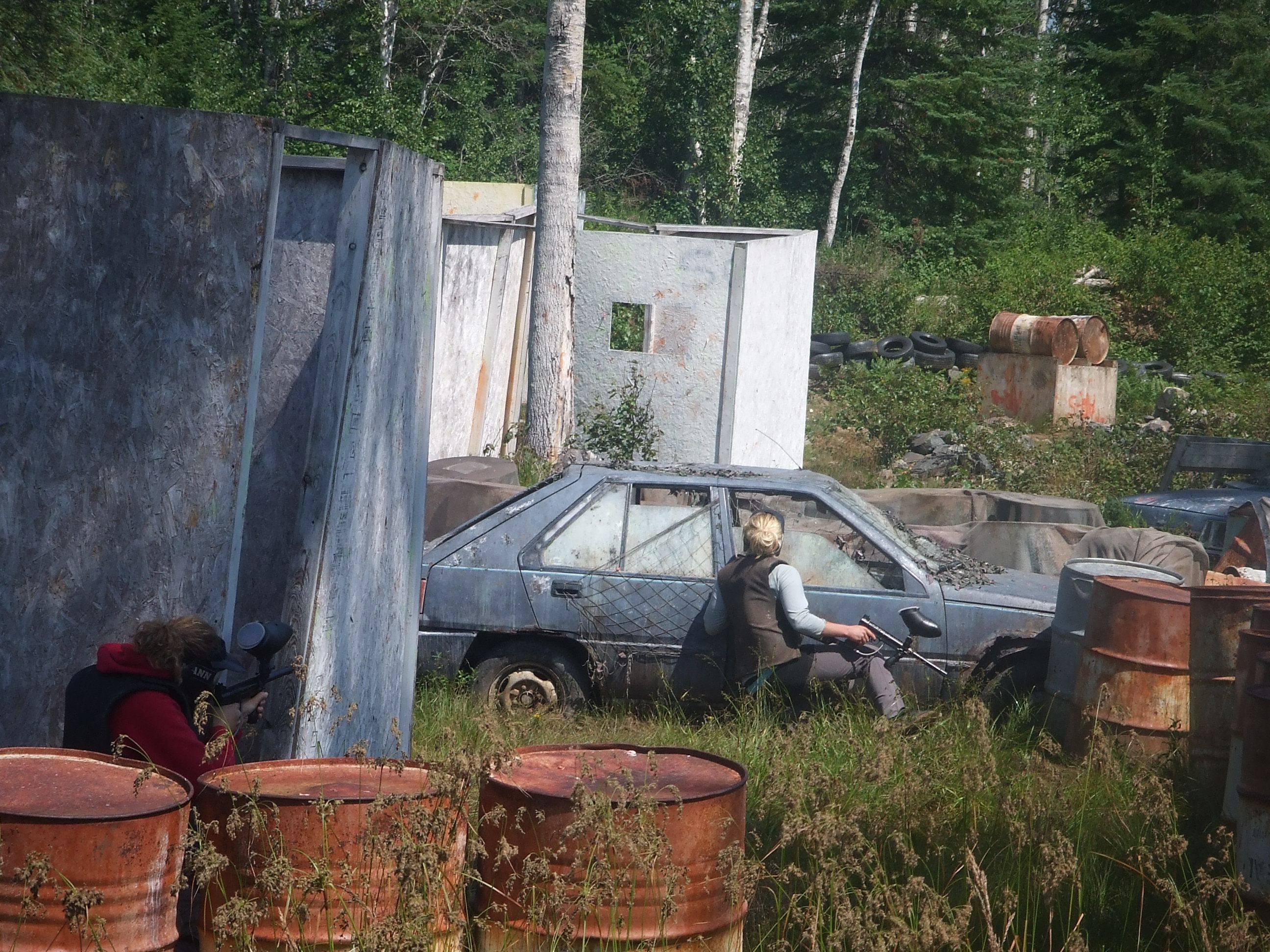
Above is a picture of a paint-ball adventure I went on years ago while doing youth work. It’s not just the fact that someone came up with the idea of paint-balling that is impressive, but that people have put their imagination into action and created a source of fun and entertainment using forest landscape, old dump-yard materials, and a concept of war-related, adrenaline-seeking excitement to draw people in to a real life video game.

I loved and hated it at the same time. Either way, the invention of paint-ball parks fascinates me in the same way all the items of the following list fascinate me:

cell phones, flip-flops, the Great Wall of China, engines, bridges, art – of all kinds, sail boats, paddle boats, airplanes, dance choreography, welding, yoga mats, fabric, gardens, backpacks, musical instruments, wood products, plastic, plastic surgery, any surgery, architecture, landscaping, sports, cultural norms, chanting, facebook, smart boards, smart cars, haul trucks, trains, igloos, tents, umbrellas, Gortex, space shuttles!, moon boots, hair spray, t-shirts, the lonely planet guides, film, National Geographic, publishing, electricity, toilets, corn rolls, keys, money, dog leashes, paper clips, zip ties, the Colosseum, stadiums, sound systems, machine guns, paint-ball guns, video games, computers, computer games, computer programs, i-everythings, blogging, microwaves, recipes, chemistry, ceramic tiles, to-go mugs, bus tickets, bingo, television, hair elastics, and ice cube trays.

Everything has been created. Each person chooses how to use his or her creativity – pro-socially or for personal advancement. Either way, we have certainly proven that creativity knows no bounds. Some people are cynical about the direction the world is going in. I agree we need to be better aware of the impact of our actions on ourselves, other living beings, and on our planet. With our potential for creativity, however, also comes the potential for problem-solving.

I don’t doubt that with each social problem we face, someone or a group of people will always rise to advocate for an innovative approach to bringing greater peace and justice to way we deal with issues collectively or through social movements. It’s the people who have either given up on tapping into their creativity all together or who have resigned to use their creativity destructively that push the pro-social innovators to innovate, move, and create change.

Thank you to all of the movers, shakers, and people who are willing to take a stand in a creative way. Songs, art, documentaries, poetry, photography, and dance are among some of the most powerful ways to communicate a message so that people will hear.


Take your Ativan, Ritalin, Risperidone, and Prozac Mindfully.

prescriptionIt would be impossible to state whether I am pro- or anti-medication in any generalized way. Whether to take medications or not is a personal choice and one that, no matter what my opinions about systemic issues are, is one that needs to be respected and I do listen and respect that choice when working with people individually. But the way our current medical and psychiatric system operates is beyond f*#@ed. Pardon my language. I do think we all have a responsibility in addressing some of the issues I would like to address.

I am not even sure what taking your meds mindfully would really entail. I guess I am trying to point out the fact that relying on medications vs. developing the skills of mindfulness, self-soothing, and restoring your state of well-being are contradictory to one another. Some professionals encourage both: they may prescribe a medication in order for the patient to get themselves to a state where they are willing and able to at least become motivated to begin making lifestyle changes. More often, the prescribed medications are the stand alone solution offered, along with a diagnosis that is experienced by the patient as a sentence to a life of dysfunction.

On this topic, I tend to think of one youth in particular who was referred to me because of her “anger issues”. As many other youth I work with, she was diagnosed with Attention Deficit Hyperactivity Disorder (ADHD) and Oppositional Defiant Disorder (ODD). In addition, she had 4 other diagnoses related to her learning difficulties and was on 3 different medications aimed to address her anxiety, behavioral impulsiveness, depression, sleep disorder, and more. What the f? Seriously. Teenagers who see a psychiatrist for feelings of anger and violent tendencies are prescribed anti-psychotics and in some cases the same anti-psychotics that are prescribed for people who are in the late stages of dementia. This young girl I am referring to in particular could rime off her diagnoses and what she had learned from her experience was that she was, in fact, incapable of paying attention, healing herself, and maintaining meaningful social relationships. In a group setting, when we would lose her attention and try to draw her back, she would say “oh sorry, that’s the ADHD”. When her peers would give her feedback that she was not acting appropriately, she would shout out ‘it’s not my fault, I have x, y, z”. I didn’t even know where to start. All I knew was that this was a reflection of a systemic problem that needed some attention. It remains an area of our health care system I am committed to learn more about, challenge, and contribute to. My work often involves teaching people to unlearn some of the ways they have been taught to think about themselves and the world around them. More and more, I rely on practices of teaching mindfulness.

The psychiatrist I consult with at work once said “a learning disability is just another way of saying that a person’s brain doesn’t function in the way our education system has been developed to teach kids what they need to know in order to successfully get into university”. Ken Robinson, in his book The element: how finding your passion changes everything presents a case study of a young girl who was brought to him by her parents when she was 8, wondering about her difficulties focusing in class and whether or not there was something “wrong with her”. After observation, Robinson pointed out to the parents that their 8 year old girl simply loved to dance. He prescribed dance lessons as a way of addressing her inability to focus in class. That same young girl is now the woman who is behind the creation of some of the world’s most famous musical theater productions, including Cats and The Phantom of the Opera.

This is a complex topic and not one that holds any simple solution. I have worked with some kids who I would say do need to be medicated (hopefully, temporarily). Most often, however, I advocate for young people and their families to turn to medications as a very last resort… if at all. When university students are crushing Ritalin and sorting it as a way to stay awake while pulling an all-nighter to cram for an exam, you have to wonder how a 5 year old can be legally prescribed the same drug. A 5 year old medicated child may make the lives of his or her teachers and parents easier, but we are depriving that same child of many opportunities to learn and grow. That’s the age that many of the teenagers and adults I work with began to take medication: at the ripe age of 5.

It’s not just the diagnosis and associated prescriptions that matter, but the way the individual interprets what each of those elements of their care mean about who they are and what their potential is limited to.

Thich Nhat Hahn, a Vietmanese Zen monk and world-renown teacher of mindfulness, says “Mindfulness is when you are truly here, mind and body together. It gives birth to joy and happiness. Another source of happiness is concentration. The energy of mindfulness carries within it the energy of concentration.” Everyone has the potential of developing a mindful state of being. The thing is, some people need to move in order to concentrate.


Navigating a Spiritually Ambiguous World

Indians-Spirituality-6The human mind, body, and spirit are amazing elements of an intriguing interconnection of something I still haven’t quite fully grasped – and never will. I woke up this morning thinking about the very basic notions of life and death; the certainty of the impermanence of life and the ambiguity of the afterlife. I know…morbid and deep thoughts to be having first thing in the morning. Have you ever had those weird moments when you really wonder what the point of it all is and what our very human existence is all about? I get into these moments of taking myself very seriously about things (as I have blogged about before) and then I snap out of it and wonder what the hell the point of of it all is – the point of life and our human emotions, mostly.

To be, or not to be: that is the question:
Whether ’tis nobler in the mind to suffer
The slings and arrows of outrageous fortune
Or to take arms against a sea of troubles,
And by opposing end them?

You know when you have one thought and then it leads to another, then another? So, I googled (yes – “to google” is now officially a verb) the famous soliloquy spoken by Hamlet. It sparked a reflection about the different ways in which people experience seemingly unbearable circumstances in life. I ask every single young person that I work with, at some point in our work together, whether they have ever contemplated suicide. Sometimes, I get a clear “yes” along with a series of stories of past suicide attempts. If I hadn’t asked the question outright, I may have never known. Other times, I get a clear “no” and they have a puzzled look on their faces, wondering why I would even ask such a question. More often than not, the response I get is “no, but I have definitely thought about it or thought about wishing my life would just end”. These conversations then sometimes lead us down a path of discussing beliefs systems and I ask the person who is sitting in front of me to share a bit about what they believe about life and death; what they believe about mental health and their own capacity to live a happy and healthy life; what it is that keeps them going despite the examination of whether it is worth living and believing rather than bringing it all to an end at the risk of not knowing what comes in the afterlife.

The spiritual ambiguity of the world we live in is fascinating to me. By spirituality, I would like to step away from direct association with religion. I would rather look at it from the perspective of how one makes sense of life and death and how one navigates the certainty that life will someday come to an end, without any agreed upon evidence of what comes next. You have people who cling to a belief system and share their understanding of it as a truth they have come to know with certainty – this faith in something may be the very thing that gives them the strength to wake up each morning with a willingness to be and accept the cards they have been dealt. You have others who describe an aversion to religion and state that they don’t believe in anything and see life in a much more logical and pragmatic way – sometimes with a cynicism that causes more suffering. And then you have those that lie anywhere in between the two extremes of dogmatic beliefs and complete non-belief in anything. One could argue that a complete non-belief in anything is a belief in and of itself.

I am not really sure where I am going with this thought. It’s sort of a weird reflection to be sharing and yet it’s one I think about often. Why? Scientific evedence has shown that those who have a spiritual belief, according to the definition I gave above, demonstrate a greater ability to overcome the adversity of life. Is this because of a simple ability to embrace the uncertainties of life? One great psychiatrist who has explored this notion is Viktor E. Frankl, in his descriptions of his experiences of having laboured in four different Nazi death camps and his examination of lessons on spiritual survival. In his book, Man’s Search for Meaning, Frankl agrees with many others who have studied and explored this notion: “we cannot avoid suffering but we can choose how to cope with it, find meaning in it, and move forward with renewed purpose”. After all, we each make up our own meanings and interpretations of all the things we can never know with any certainty.

I also googled images for “spirituality”. I got the kind of images you are probably imagining. Try it. There are some funny representations out there that fit the stereotype of an image that you are probably imagining – cosmic art, silhouettes dancing in the sky, and tunnels of light. The image I attached in this post was one of the more grounded ones. I somehow thought a grounded representation of spirituality felt more normal – whatever that means.

Namaste – The spirit in me salutes the spirit in you – with total and complete ambiguity of what that even means.

On Love.

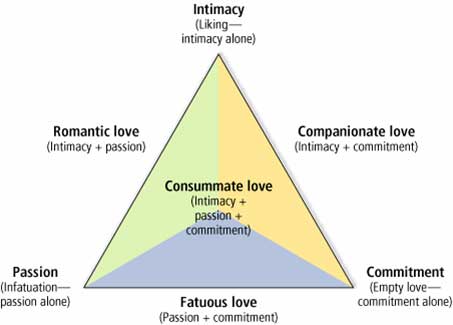
sterberg's types of loveThere are many different types of love and, at the same time, love can really just be love. You can categorize it and associate other emotions to it based on the person toward whom you experience your love. The experience of loving and being loved unconditionally, however – on whatever level – is one that is essential to our human growth and sense of wellness.

In his Theory on Love, Sternberg speaks of 8 types of love that are built on three main building blocks: intimacy, passion, and commitment. According to his theory, Comsummate love – where all three ingredients are present – is the ultimate combination for a successful long-term partnership. Sternberg’s model sheds a lot of light on the different choices people will make in their life as a couple. Lately, I have been thinking a lot about love beyond the scope of just couples, however. Friendships, family members, acquaintances, neighbours, co-workers, and self-love are all relationships in which love can be experienced in different ways. Sometimes, the appropriate kind of love simply entails being caring, respectful, and mindful. It’s still love and it’s still something that we all need and desire for our happiness.

What has really struck me lately, is the fact that there are people in this world who don’t know what that experience of being loved unconditionally really feels like. Or, when it is present, some have no idea how to allow it to just be and receive it. When I am working with people in the context of counselling, it doesn’t matter what the initial concern is that brought them to seek help in the first place is. It almost always boils down to a complaint about a relationship in their lives that is lacking the kind of love they desire. Or, the complaint may simply be that they don’t have an experience of love in any of their relationships. The complaint may be a deep sense of loneliness. It is in this sense that I equate love to happiness and belonging. We are social beings and our way of relating to ourselves and others is really the only thing we have to base our experience of life on. Think about the conversations you have with friends and family. Are social relationships and a desire to be liked, loved, and understood not at the forefront of what we all tend to spend some of our energy on?

If we refer to the Yoga Sutras of Patanjali (yogic text), the causes of suffering, or kleshas, are all rooted in the notion of wrong perception (avidya). Meaning, when suffering is present, there is a discrepancy between reality and the way one perceives reality. This wrong perception, when we are taking about love and suffering, may boil down to a mistaken interpretation such as “I am unlovable”, “no one will ever love me”, “something must be wrong with me because I can’t get the kind of love I want”, “people always leave me”, “I hate people for what they have done to me”, “I can’t ever trust anyone to truly love me and be trusted with my love”, “I will never risk loving again because people hurt me”, “I can’t let him/her go, because I don’t want to be alone”, “love isn’t real”, “I have given up on believing in love”. Referring to the causes of suffering again, the ego (asmita) is an influential part of the way in which the individual interprets his or her experiences. Whether it is based on an attachment or desire (raga), on fear (abhinivesa), or on an aversion to something that we don’t want to re-experience (dvesa), our ego values being right and making others wrong. Our ego will seek protection, and this is where our wrong perceptions and interpretations of who we are can actually get in the way of having the love that we need and want.

Take a moment today to reflect on love. Drop out of your thinking mind and experience the love. After all, love is all you need. For some, that comes easily. For others, it takes work in peeling away all the layers of mistaken beliefs that would allow love to be.

Emotional Equality for Boys and Men – The Flip Side of Feminism

dialogoHere, I will not speak of the inequalities faced by women. I am a woman, speaking of the privileges that come with being a woman. Fighting for women’s rights is something I am extremely grateful to our ancestors and modern day feminists for. I will not, in any way, dispute the role that the various forms of feminism and other social justice movements have played in bringing greater equality to the way in which our current systems are constructed. As a 32 year old female in 2013, living in Canada, I am experiencing the positive outcomes of the past century’s women’s rights movement. Now, how can we continue to stand up for equality in a way that doesn’t leave our boys and men behind?

Let’s first take a look at the very notion of gender equality. Equality, in my perspective, is much more subjective than the way we often reference it. The word equality is commonly used to describe balance, equal access, mutual respect, sameness, and promotion of horizontal rather than vertical structures of power distribution. In our history of fighting for gender equality, the focus has been on breaking down the barriers encountered by women, mostly, to have access to rights and privileges that are equal to those of men within patriarchal realms. The Lesbian/Gay/Bisexual/Trans/Queer communities have definitely brought an additional layer to the gender equality debates in recent decades by challenging the definition of gender in and of itself. These communities have joined with other social movement groups in raising awareness of where the real inequalities exist. What if you aren’t part of a group and aren’t sure what your identity is, but somehow experience a power imbalance in the way you are permitted, or not, to be who you truly are and express yourself openly and freely? I don’t think that it’s just about gender, but there are inequalities that are certainly constructed within social expectations of what it means to be a man and what it means to be a woman. Layered and intertwined with these notions of gender-specific inequalities, we find the barriers related to economic class, race, culture, religion, ability, and more.

So, what does gender equality really look like today? I’m actually not sure because of how complex gender identity and social equality have become. What I am sure of is that many of the boys and young men that I work with have been emotionally deprived of the ability to heal and talk about some of the inequalities they have truly experienced because of the additional layer of inequality that exists within the context that boys and men are often taught to hide, suppress, and avoid certain deep emotions. Basically, the boys and young men I work with have demonstrated to me a layer of inequality that is socially constructed and one which women are not the victims of. More often than not, women are given the freedom to express emotions, speak truth, and be vulnerable. Growing up as a girl is different than  growing up as a boy. I don’t think we can argue anymore that one or the other is better or worse from a perspective of equality. We can only argue that one is better or worse on the basis of his or her freedom of expressing who they are, healing from past wounds and dealing with real emotions freely and wholeheartedly.

Yes, women are the victims of male-perpetrated crimes. Men are also, and even more dramatically so, the victims of male-perpetrated crimes. Rather than focusing solely on the suffering experienced by the victims, I suggest we draw our attention to the suffering experienced by the perpetrators which is causing the replication of suffering among each person he (in cases where it is a man) takes it out on. The experience of being in a room with a group of court-mandated teenage guys and creating the context for them to talk about and name their feelings is something I do not take for granted. For them to be given permission, with each other, to talk openly and safely about the effects of male-on-male violence, bullying, the pain and anguish that resulted from the abandonment of their fathers, or the abuse they lived growing up, or the simple messages they have received about needing to act tough and never cry – for them to be given the freedom to express everything they have been taught to suppress is something I love being a part of. It’s also hilarious in a way that comes from the way in which they bring humour to every deep conversation.

Depending on how you look at it, anyone can experience inequality. It’s a privilege to be granted permission to talk about and express deep emotions without the fear of being rejected or put down. In today’s western world, women not only have the right to vote, thrive in their careers, and stand up for inequalities, but we also have the right to do it with passion and emotion. Let’s raise all children to have equal access to that.